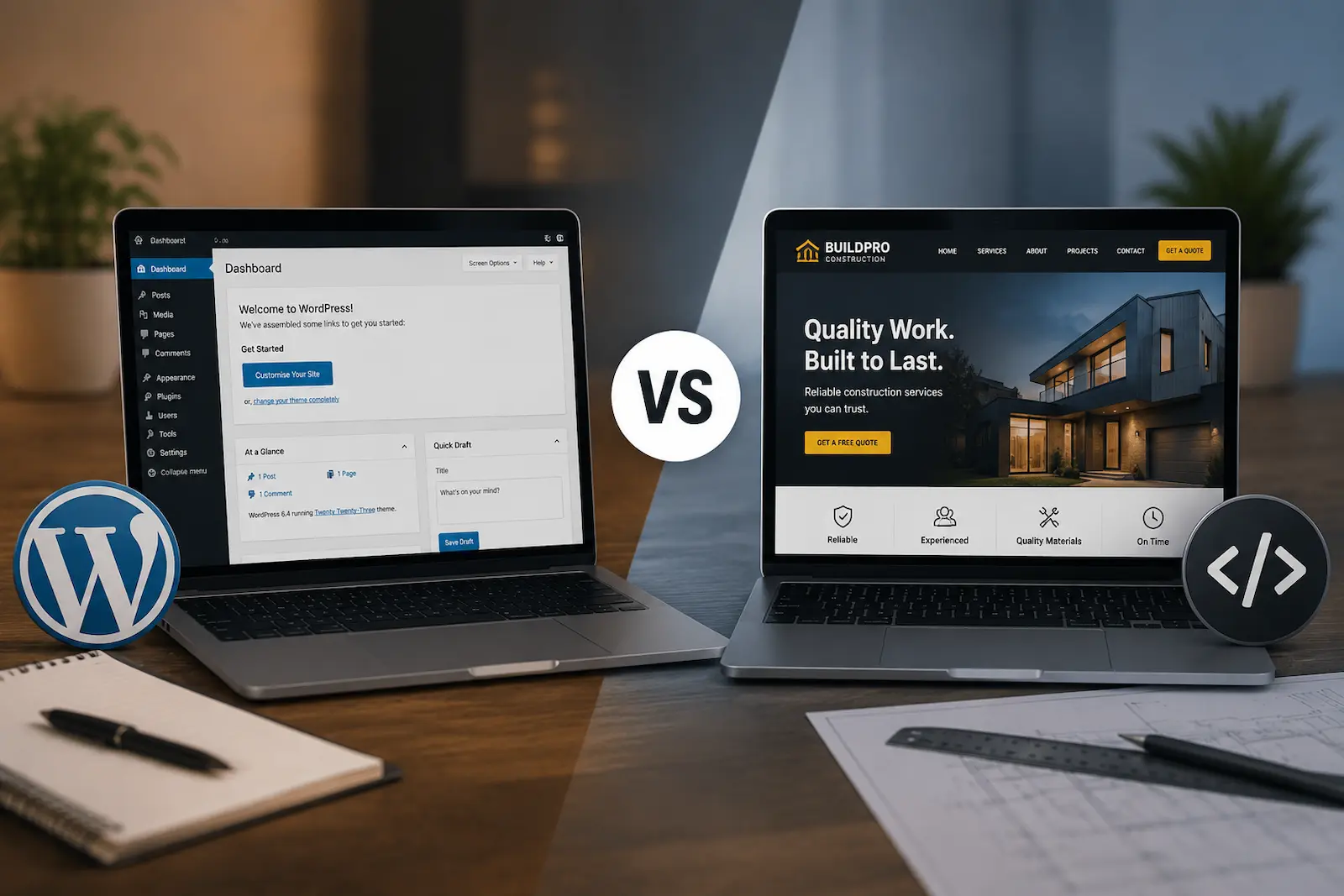
WordPress vs Custom Websites for Tradespeople
Many tradespeople who consider building a website eventually face the same question:
Should I use WordPress, or should I invest in a custom-built website?
Both options can work well depending on a number of factors, but they offer very different advantages, costs, flexibility, and long-term results.
For plumbers, electricians, builders, roofers, landscapers, and other trade businesses, choosing the right type of website can greatly impact:
- SEO performance
- Lead generation
- Website speed
- Maintenance
- Branding
- Long-term business growth
In this article, we’ll compare WordPress websites vs custom websites for tradespeople and explain which option may be best depending on your business goals.
What Is a WordPress Website?
WordPress is one of the most popular website platforms in the world.
It powers millions of websites and allows users to create websites using:
- Themes
- Plugins
- Page builders
- Content management systems
WordPress is popular because it makes website management much easier for non-technical users.
Many trade websites are built using WordPress and can be managed directly by tradespeople themselves. They also have the option of hiring someone to create and maintain the website for them.
What Is a Custom Website?
A custom website is built specifically for a business instead of relying heavily on pre-made themes or templates.
Custom websites are usually developed using modern web technologies such as:
- React
- Next.js
- Tailwind CSS
- HTML/CSS/JavaScript
Instead of modifying an existing template, the website is designed and developed around the business itself. Many businesses choose custom websites because they offer greater flexibility, speed, and long-term scalability.
Why Website Choice Matters for Tradespeople
For trade businesses, a website should do more than simply look professional.
It should help:
- Generate leads
- Rank on Google
- Build trust
- Convert visitors into customers
The platform and structure behind the website can affect all of these areas, even if the visual appearance of a WordPress website and a custom-built website may look similar.
A good-looking website with poor functionality will eventually create problems for a business.
You may also want to read:
Advantages of WordPress for Tradespeople
WordPress remains popular for good reasons.
Easier Content Management
One major advantage is simplicity.
Tradespeople can often:
- Edit text
- Upload photos
- Add blog posts
- Update services
without needing coding knowledge.
This makes WordPress attractive for businesses wanting direct control, as they can log in to their admin dashboard and edit content themselves.
That said, not all trade businesses want this option. Many prefer having a developer handle updates and maintenance instead.
Lower Initial Costs
Many WordPress websites cost less upfront compared to fully custom websites.
Themes and plugins reduce development time, which can make WordPress appealing for:
- Small businesses
- Startups
- Tradespeople on tighter budgets
Huge Plugin Ecosystem
WordPress offers a large number of plugins for almost everything, including:
- SEO tools
- Contact forms
- Booking systems
- Security
- Image galleries
- Reviews
This flexibility allows businesses to add features quickly.
Good SEO Potential
WordPress can perform very well for SEO when built properly.
With good optimisation, WordPress websites can:
- Rank well on Google
- Generate leads
- Support local SEO
Many successful trade businesses use WordPress effectively.
Disadvantages of WordPress for Tradespeople
Despite its popularity, WordPress also has limitations.
Slower Website Speeds
Many WordPress websites become slower over time.
Common causes include:
- Heavy themes
- Too many plugins
- Poor hosting
- Bloated page builders
Slow websites hurt:
- SEO
- User experience
- Conversions
Website speed is especially important for local trade searches. A poorly built WordPress site can significantly impact the overall experience for potential customers.
Clients want quick and easy access. Delays can quickly push them towards competitors.
Security and Maintenance Issues
WordPress websites require regular:
- Plugin updates
- Theme updates
- Security monitoring
- Backups
Outdated WordPress websites can become vulnerable to security issues.
This ongoing maintenance is often overlooked, meaning lower upfront costs can sometimes lead to additional problems later on.
It’s also easier for inexperienced users to accidentally break parts of a WordPress website while editing content, which can result in downtime or additional support costs.
Generic Designs
Many WordPress sites rely heavily on templates.
Because of this, a number of trade websites can end up looking very similar to competitors.
This makes branding more difficult and can dilute the unique identity of the business.
Plugin Dependency
Some WordPress websites rely heavily on plugins.
This can create:
- Performance issues
- Compatibility problems
- Security risks
- Maintenance headaches
Over time, plugin-heavy websites can become difficult to manage.
When a tradesperson gets a WordPress website built, they are often promised a large number of plugins. However, it’s important to ask what those plugins actually do and whether they are genuinely beneficial.
Advantages of Custom Websites for Tradespeople
Custom websites are becoming increasingly popular for businesses focused on performance and lead generation.
While they can seem more intimidating compared to the user-friendly nature of WordPress, a properly built custom website can provide major long-term advantages.
Faster Website Performance
Custom-built websites are often significantly faster than traditional WordPress websites.
Technologies like Next.js allow websites to load extremely quickly.
Why Speed Matters
Fast websites:
- Rank better on Google
- Improve user experience
- Reduce bounce rates
- Generate more enquiries
For emergency trade searches, speed can directly affect lead generation.
A potential customer may be panicking while searching for a plumber, but your website is slow and clunky. They will not wait for your website to load — they will move to a competitor’s website that is easier to use.
Better SEO Performance
Custom websites often provide stronger technical SEO foundations.
This includes:
- Cleaner code
- Better performance
- Improved Core Web Vitals
- Faster mobile loading
- Better site structure
SEO is one of the main reasons businesses choose custom websites.
A properly optimised custom website can continue generating leads and visibility for years.
You may also find these guides helpful:
More Unique Branding
Custom websites are designed specifically around the business.
This allows:
- Stronger branding
- More flexibility
- Better layouts
- A more premium appearance
For tradespeople competing in busy markets, strong branding can create a major advantage.
The layout, branding, colours, and overall presentation all influence how professional a contractor’s business appears online.
Better Mobile Experience
Custom websites are often designed mobile-first.
This creates:
- Better usability
- Faster mobile performance
- Improved conversions
Most trade-related searches now happen on mobile devices.
This matters even more for emergency trades, where users want a simple, mobile-friendly experience immediately.
Easier Scalability Long Term
Custom websites are often easier to expand strategically over time.
For example, businesses may later add:
- SEO landing pages
- Blog systems
- Service area pages
- Lead-generation tools
- CMS integrations
A properly structured custom website can scale much more efficiently as the business grows.
Disadvantages of Custom Websites
Custom websites also have drawbacks.
Higher Initial Cost
Custom development usually costs more upfront.
This is because:
- The website is built specifically for the business
- More development work is involved
- SEO and performance are often prioritised
For smaller businesses, the higher upfront cost can sometimes feel difficult to justify initially.
Requires the Right Developer
Not all developers understand trade businesses or SEO.
A poorly built custom website can still fail to generate leads.
It’s important to work with someone who understands:
- Local SEO
- Conversion-focused design
- Mobile optimisation
- Lead generation
Content Management Can Be More Complex
Some custom websites require developer support or more advanced content management systems for updates.
While modern CMS platforms help simplify this, some trade businesses still prefer the familiarity of WordPress.
It’s also important to understand that not all custom websites are built the same. Moving a custom-built website from one developer to another may not always be straightforward.
Which Option Is Better for SEO?
Both WordPress and custom websites can rank well on Google.
However, custom websites often have advantages in:
- Speed
- Technical SEO
- Core Web Vitals
- Mobile performance
That said, SEO success still depends heavily on:
- Content quality
- Local SEO
- Site structure
- Reviews
- Internal linking
A poorly optimised custom website can still perform badly.
And a well-built WordPress website can still rank extremely well.
The overall strategy matters more than the platform alone.
Which Option Generates More Leads?
The answer depends less on the platform itself and more on how the website is built.
A lead-generating trade website should include:
- Strong calls to action
- Mobile optimisation
- Fast loading speeds
- Service pages
- Reviews
- SEO-focused structure
However, custom websites often provide:
- Better performance
- Better branding
- Faster speeds
- Stronger user experience
- More unique features
which can improve conversions over time.
Which Option Is Better for Tradespeople?
WordPress May Be Better If:
- You want lower upfront costs
- You need easy content editing
- You want a simple website quickly
- Your business is still very small
- You’re comfortable managing updates
Custom Websites May Be Better If:
- You want stronger SEO performance
- You want faster speeds
- You want premium branding
- You want better lead generation
- You want long-term scalability
- You compete in a busy market
For many established trade businesses, custom websites provide stronger long-term advantages.
The Real Question Isn’t WordPress vs Custom
The real question is:
“Will the website help generate leads and grow the business?”
A fast, SEO-focused WordPress website can outperform a poorly built custom website.
And a well-developed custom website can dramatically outperform a generic template site.
The quality of the strategy matters more than the platform itself.
Final Thoughts
So, should tradespeople choose WordPress or a custom website?
Both can work well and offer their own advantages.
WordPress Offers:
- Simplicity
- Lower upfront costs
- Easier management
Custom Websites Offer:
- Better performance
- Stronger SEO foundations
- Faster speeds
- More unique branding
- Greater scalability
For tradespeople serious about long-term growth, lead generation, and SEO, custom websites often provide stronger long-term value.
But the most important thing is having a website that is:
- Professional
- Fast
- Mobile-friendly
- SEO-focused
- Designed to generate enquiries
That’s what truly drives business growth.
Most customers will not care whether a website uses WordPress or a custom framework. They care about speed, usability, trust, mobile experience, and how professional the business appears online.
If you’re still deciding whether your business needs a website at all, read:
FAQ Section
Is WordPress good for trade websites?
Yes. WordPress can work well for trade websites when properly optimised for SEO, speed, and mobile performance.
Are custom websites better for SEO?
Custom websites often provide stronger technical SEO performance due to faster speeds and cleaner code.
Which is cheaper: WordPress or custom websites?
WordPress websites are usually cheaper upfront, while custom websites often cost more initially but may provide stronger long-term performance.
Can custom websites generate more leads?
They can, especially when designed for SEO, mobile optimisation, and conversion-focused lead generation.
What matters most for a trade website?
The most important factors are SEO, speed, mobile usability, trust signals, and conversion-focused design.